

A new generation of solar catalyst converts biomass into raw materials for bioplastics
An international team of scientists, including experts from CATRIN at Palacký University, has developed a new type of plasmonic photocatalyst capable of converting biomass into key raw materials for bioplastic production with high efficiency and selectivity using solar energy. The research results, which represent a significant step towards more sustainable chemical manufacturing, have been published in the prestigious journal Nature Catalysis.
Biomass—organic material of plant or animal origin—is among the most promising renewable resources for the production of high value-added chemicals and materials. The research focused on the molecule 5-hydroxymethylfurfural (HMF), which is derived from sugars contained in plant biomass and is regarded as one of the key intermediates in modern biorefineries. Through controlled oxidation, HMF can be converted into 2,5-furandicarboxylic acid (FDCA), a compound that serves as a fundamental building block for biopolymers, such as PEF plastic, an environmentally friendly alternative to the widely used PET.
However, current industrial methods for producing this compound are technologically demanding. They often require strongly alkaline conditions, elevated temperatures, or increased pressure. Despite this, they suffer from low selectivity, leading to the formation of unwanted by-products and higher energy consumption. As a result, contemporary research is seeking new approaches that would allow this chemical transformation to be driven by light energy under milder and more environmentally friendly conditions.
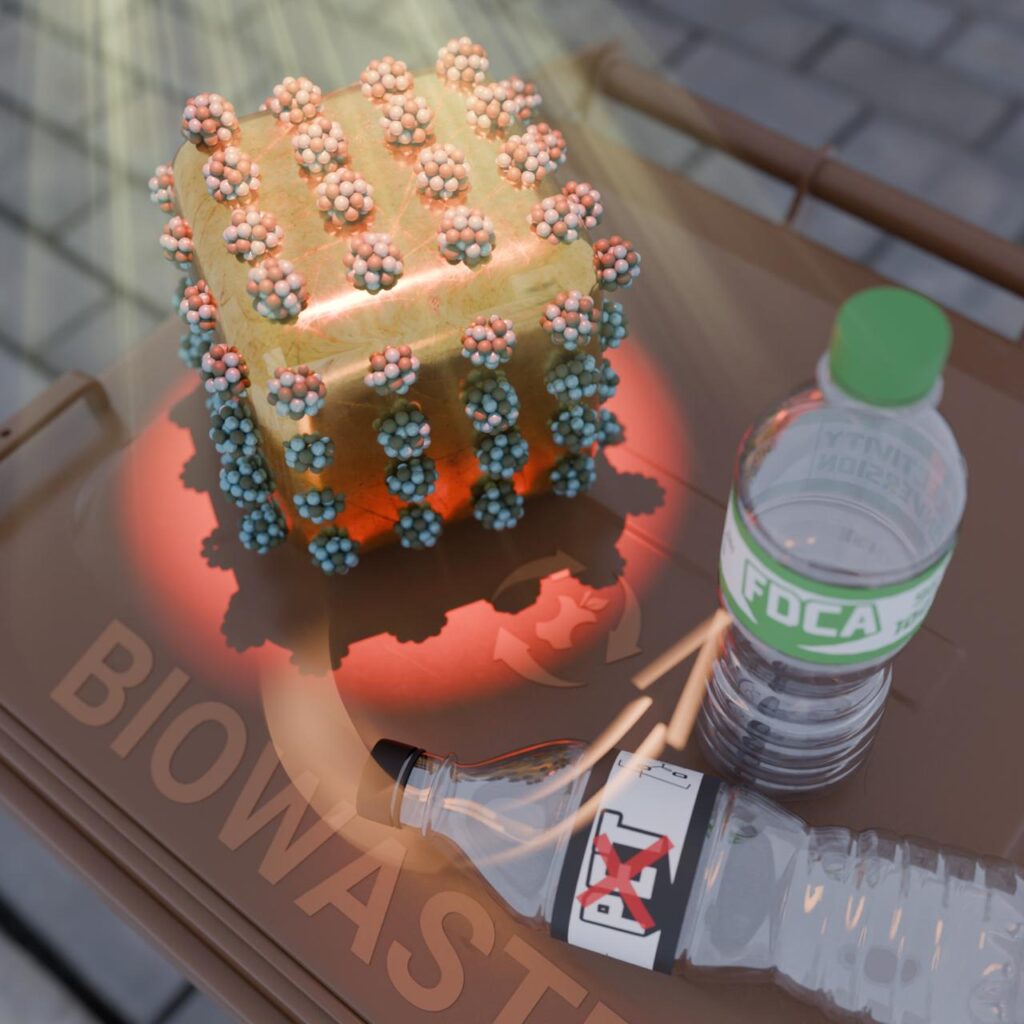
The newly developed catalyst is based on a combination of nanostructured titanium nitride and extremely small nanoparticles of a ruthenium–platinum alloy. Titanium nitride acts as a material that very efficiently absorbs light, particularly its infrared component, converting it into energy-rich electrons and local heat. These effects subsequently promote the activation of molecular oxygen on the surface of the catalytically active nanoparticles, where the chemical reaction itself takes place.
“The key aspect is that the individual components of the catalyst work together in perfect synergy. This allows us to control the oxidation of 5-hydroxymethylfurfural with great precision and achieve an almost complete conversion to the target product without the use of strong chemical additives or extreme reaction conditions. Compared with existing technologies, the process is significantly more selective, more energy-efficient, and produces substantially less waste,” said one of the corresponding authors of the study, Štěpán Kment from Palacký University.
The authors emphasise that this approach enables oxygen activation in a fundamentally different way than conventional catalytic systems. As a result, the reaction can be carried out in an aqueous environment without the addition of alkaline agents, while avoiding non-selective reactions that would otherwise lead to material losses. The outcome is a highly efficient and precisely controlled process suitable for future applications.
According to the researchers, this plasmonic catalytic platform represents a previously unexplored concept in the field of biomass conversion. “It opens up new opportunities for future biorefineries that could use solar energy and renewable feedstocks to produce plastics, solvents, and other chemical products with a significantly lower carbon footprint than current industrial technologies,” concluded Kment.
The research involved scientists from CATRIN at Palacký University, the Centre for Energy and Environmental Technologies, and the national supercomputing centre IT4Innovations at VSB–TUO, in collaboration with partners from China, Italy, and the United States.