

CATRIN researchers offer a “greener” way to make supercapacitors
How can we make the production of supercapacitors for energy storage more sustainable and replace the traditionally used but toxic solvent NMP (N-methyl-2-pyrrolidone)? According to scientists from CATRIN at Palacký University, the “green” solvents Cyrene and Tamisolve may be a suitable alternative. In an article published in the Chemical Engineering Journal, they have shown that these solvents can be used in production without reducing the performance of the equipment. They thus offer a path to the next generation of sustainable, high-performance supercapacitors for industrial use.
“Supercapacitors are one of the modern technologies for storing electric energy. As sustainable energy storage becomes more prominent, it is essential to replace the hazardous solvents used in the production of supercapacitor electrodes. Our study presents Cyrene and Tamisolve as environmentally friendly alternatives to the toxic solvent NMP, which is traditionally used in production. Both tested solvents enabled the preparation of electrodes that maintain high electrochemical performance while improving environmental compatibility,” said Michal Otyepka, corresponding author of the article.
The electrodes were prepared using nitrogen-doped graphene as the active material in combination with two types of binders. The first was a common fluorinated binder (PVDF), which is widely used in industry, including in the manufacturing of battery electrodes. The researchers also tested a fluorine-free binder (PVP), which has a lower environmental impact and is more soluble in environmentally friendly solvents. Using various combinations, they monitored the performance and stability of the electrodes as well as their mechanical resistance.
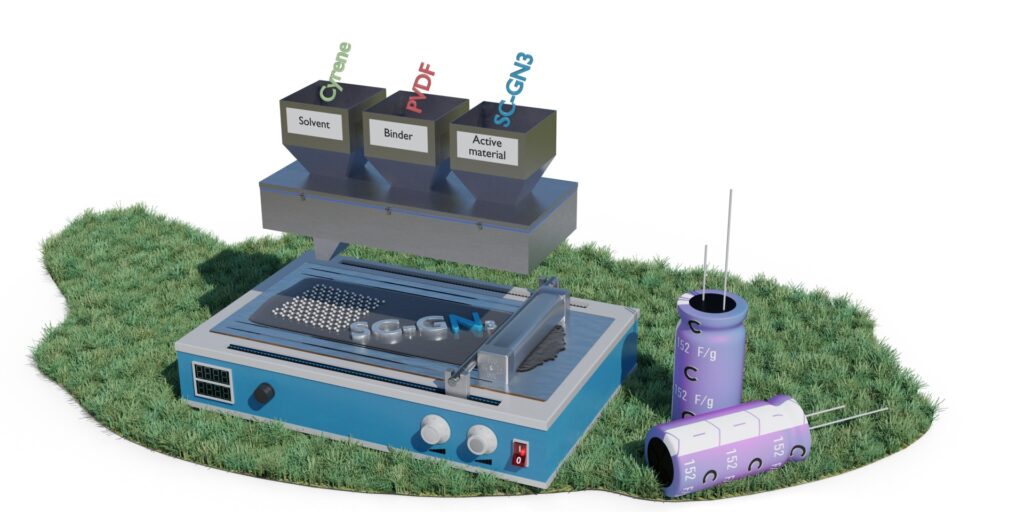
“The results showed that not only can the alternative solvents Cyrene and Tamisolve fully replace the toxic solvent NMP, but also that the prepared electrodes have the necessary mechanical properties. Their compatibility with both fluorinated PVDF and non-fluorinated PVP binders, together with excellent layer uniformity and electrochemical stability, makes them ideal for use in scalable applications. This is essential for industrial production,” said the publication’s first author, Ivan Dědek.
Cyrene, or dihydrolevoglucosenone, is obtained from renewable biomass sources such as cellulose. Tamisolve (N-butyl-2-pyrrolidone) is a substance related to the commonly used NMP, but is more gentle on human health and the environment.
Supercapacitor research has been a priority at CATRIN for almost ten years. In addition to developing new active materials, such as the successful nitrogen-doped graphene (SC-GN3), it also focuses on environmentally friendly and industrially feasible manufacturing processes. The replacement of toxic NMP with the “greener” solvents Cyrene and Tamisolve confirms that more sustainable production can go hand in hand with high performance and represents an important step towards industrial implementation.