A young chemist brings experience from a prestigious university to Czech research
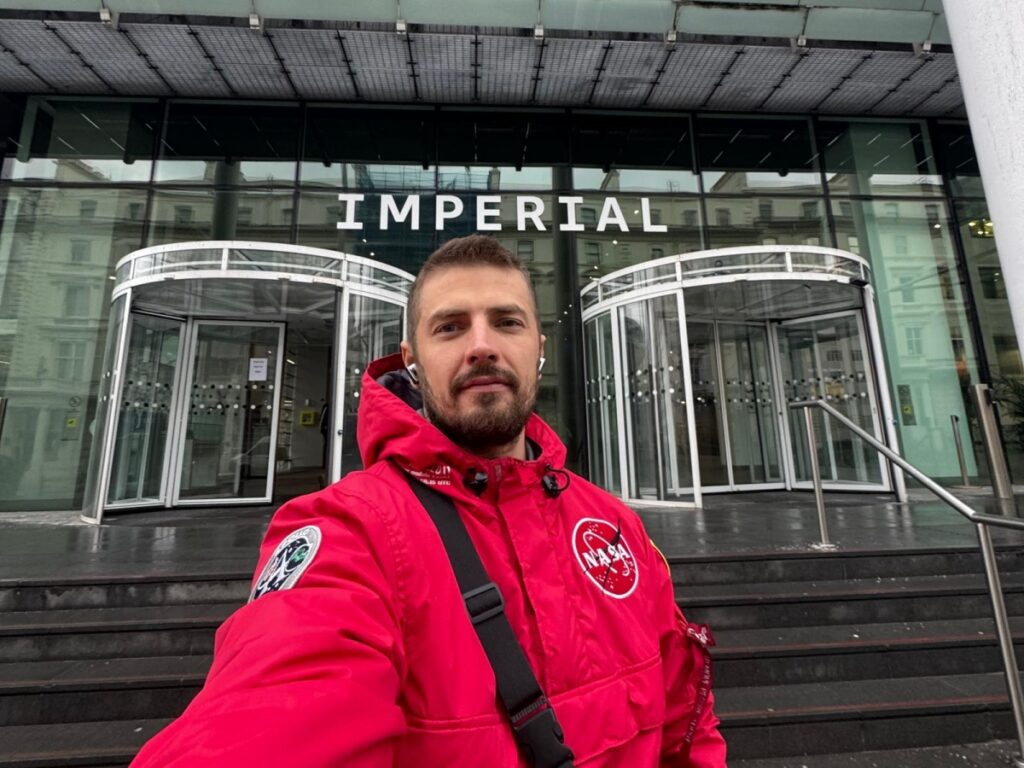
Last January, the materials chemist David Panáček from CATRIN travelled to Imperial College London, where he joined the Department of Bioengineering. Thanks to his success in the Marie Skłodowska-Curie Fellowship (MSCA) – CZ call, he spent a year working under the supervision of the renowned scientist Firat Güder. After twelve months, he returned to the Czech Republic, where he will now spend four months applying laboratory results in practice at the company AgroBioChem. His stay will conclude with a final two months in London, during which he will wrap up the entire project.
What did you work on at this prestigious international institution?
I built on my previous experience in the field of two-dimensional graphene chemistry, which I have been working on since my PhD studies. At CATRIN, graphene derivatives are used, for example, in energy storage, catalysis or biomedicine. However, the main focus of my fellowship was somewhat different. It involved the development and application of sensors for monitoring plants exposed to stress. This is precisely the area that Firat Güder focuses on, and the topic is also being developed at CATRIN. That is why we agreed to collaborate.
This was not your first longer stay abroad. What was different this time?
During my doctoral studies, I spent five months in Barcelona at the Catalan Institute of Nanoscience and Nanotechnology (ICN2). So I already knew how beneficial working abroad can be. Even so, I gained a huge amount of new experience. It was very interesting to observe how a research team operates in another part of the world. It gave me a great deal.
What did you learn? Did the laboratories differ in terms of equipment or organisation? What impressed you most?
It’s not that I discovered anything fundamentally new in the laboratory itself. From previous experience, I already knew that CATRIN ranks among the world’s best in terms of equipment. In this respect, we actually outperform the laboratory at Imperial College London where I worked. So I didn’t learn new methods or techniques as such. What really broadened my horizons was seeing how research evaluation works there and how the overall approach to work differs from what we are used to in the Czech Republic. For example, there is a very strong emphasis on evaluation. It takes place every two years, and researchers or group leaders are required to account for their results. There are clearly defined rules that apply equally to everyone. I really like this transparent system; it suits me very well. Imperial College London also places strong emphasis on transferring scientific results into practice, which I see as another very positive aspect. I learned a lot about what is needed to make that happen.
How large was the team you worked in?
It was a team of about fifteen people led by Firat Güder, a highly respected scientist of Turkish origin. Roughly one third of the team were postdocs, while the rest were students, including PhD candidates. Interestingly, I was the only European in the group. My colleagues came from China, Turkey, Canada, Brazil and Africa. The team combined not only many cultures but also different scientific disciplines, which is very typical of Imperial College London. Each group member represented a different field. I was, for example, the only materials chemist; there were also specialists purely in IT who had never worked in a laboratory. What fascinated me was that we always had to find a common language and work out together how to solve a given problem. That, too, was extremely enriching. At CATRIN, the level of internationalisation is high by Czech standards, and interdisciplinary collaboration is also strongly supported. Nevertheless, compared with leading institutions abroad, it is still different.
What are the main outcomes of your fellowship?
First of all, publications. Together with colleagues from both institutions, we prepared a review article that has just been published by Nature Communications. It focuses on new trends in monitoring crop health in agriculture. We then continued with experimental work and are now in the final phase of developing a sensor that will be the first of its kind and capable of monitoring plant behaviour under stress conditions. Within about six months, we would like to prepare a publication presenting these results. I am also very much looking forward to the part of the project where we move beyond the laboratory and test the results at AgroBioChem, directly in greenhouses and under real conditions. That is a unique opportunity and a valuable experience.
This time you were abroad with your family as well. Was it difficult?
It was extremely challenging, particularly because London is among the most expensive cities in the world. Living there is incredibly costly, including housing. For example, some of my colleagues had to commute to work for up to two hours by train every day because they could not afford to live closer. Others opted for shared accommodation, but that was not an option for us with my wife and two children. We lived in a studio flat of 28 square metres. One room served as the living room, bedroom, children’s room and kitchen all at once. I spent a lot of time at work doing science that I enjoy, but for my wife it was extremely demanding.
So you did not feel tempted to stay abroad?
I have to admit that I did receive an offer. However, as I mentioned earlier, I have above-standard conditions for doing science at home, especially in terms of instrumentation, so I declined it. The most important thing for me is that my family is doing well. Peace of mind is the key prerequisite for being able to perform my work at the highest level.
What are your plans now that you have returned?
My immediate task is to complete this research. After that, I will be fully prepared to apply for my first European grant, an ERC Starting Grant, which would allow me to establish my own research group. I would very much like to use the experience gained in London when leading it. These insights are, in my view, the most important thing I took away from the fellowship.