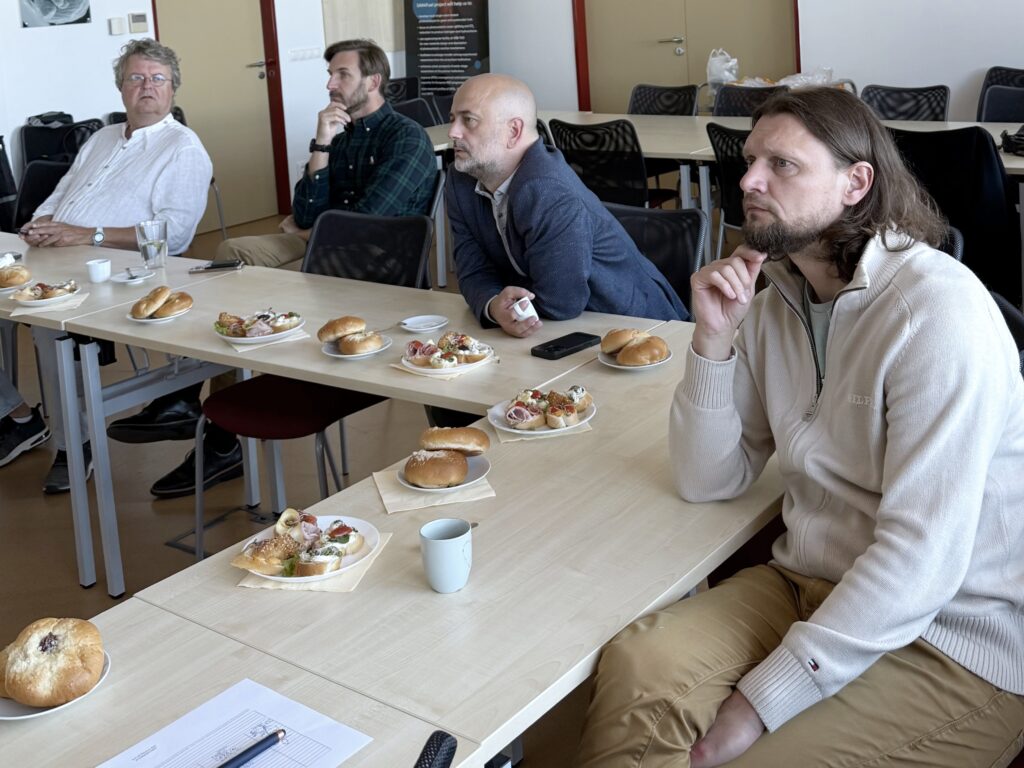

The REEactor project has been launched. It will simplify the separation of rare earth elements
Olomouc – The new REEactor technology platform addresses the growing demand for rare earth elements and the challenges associated with their extraction. Alexander Dömling from CATRIN at Palacký University has received a prestigious European Research Council grant in the Proof of Concept category to develop this platform. Together with his team, the renowned chemist aims to use automated chemistry, artificial intelligence and molecular research to speed up and streamline the separation of these raw materials, while reducing both chemical consumption and the volume of toxic waste generated during their extraction. The project was officially launched yesterday in the presence of academics and representatives from the public sector.
“Securing an ERC Proof of Concept grant is an important validation of our vision that autonomous chemistry, automation and artificial intelligence can help address one of Europe’s most pressing challenges in the field of critical raw materials. For decades, China has been building up expertise in the separation of rare-earth elements, specialised academic capacity and industrial know-how.
Rare earth elements comprise 17 chemical elements that are essential, for example, in the manufacture of batteries, electric vehicles, aeroplanes, drones, wind turbines, mobile phones, medical diagnostic equipment, semiconductors and high-performance magnets. The industrial separation of rare-earth elements is currently largely concentrated in China and is associated with a number of problems. REEactor will focus on finding the molecular key to one of the most difficult problems in the processing of critical raw materials: how to separate rare-earth elements that are nearly identical. Instead of slowly testing individual compounds, it will use automation to prepare and test tens of thousands of molecular variants, with artificial intelligence helping to identify the most successful ones.
“The main aim of the project is to demonstrate that rare-earth elements can be separated more easily, using fewer chemicals and less energy, and producing less waste. In the longer term, REEactor could help replace large, resource-intensive industrial separation plants with smaller, modular facilities that are more efficient, flexible and environmentally friendly. The transfer of the technology into industrial practice shall be carried out by the newly established spin-off company REEactor, the development of which is another objective of the project,” said Imma Capriello, CEO and Co-Founder of REEactor Tech and a member of the research team at CATRIN.
In the first round of the 2026 call for proposals, the European Research Council (ERC) awarded a total of 27.3 million euros to 182 researchers; only one project in the Czech Republic received funding. Each grant is worth €150,000 and is intended for current and recent ERC grant holders to enable them to validate the commercial or societal potential of their research results. This grant programme forms part of the European Union’s Horizon Europe framework programme for research and innovation.