When atoms work together: A new approach to more efficient water electrolysis
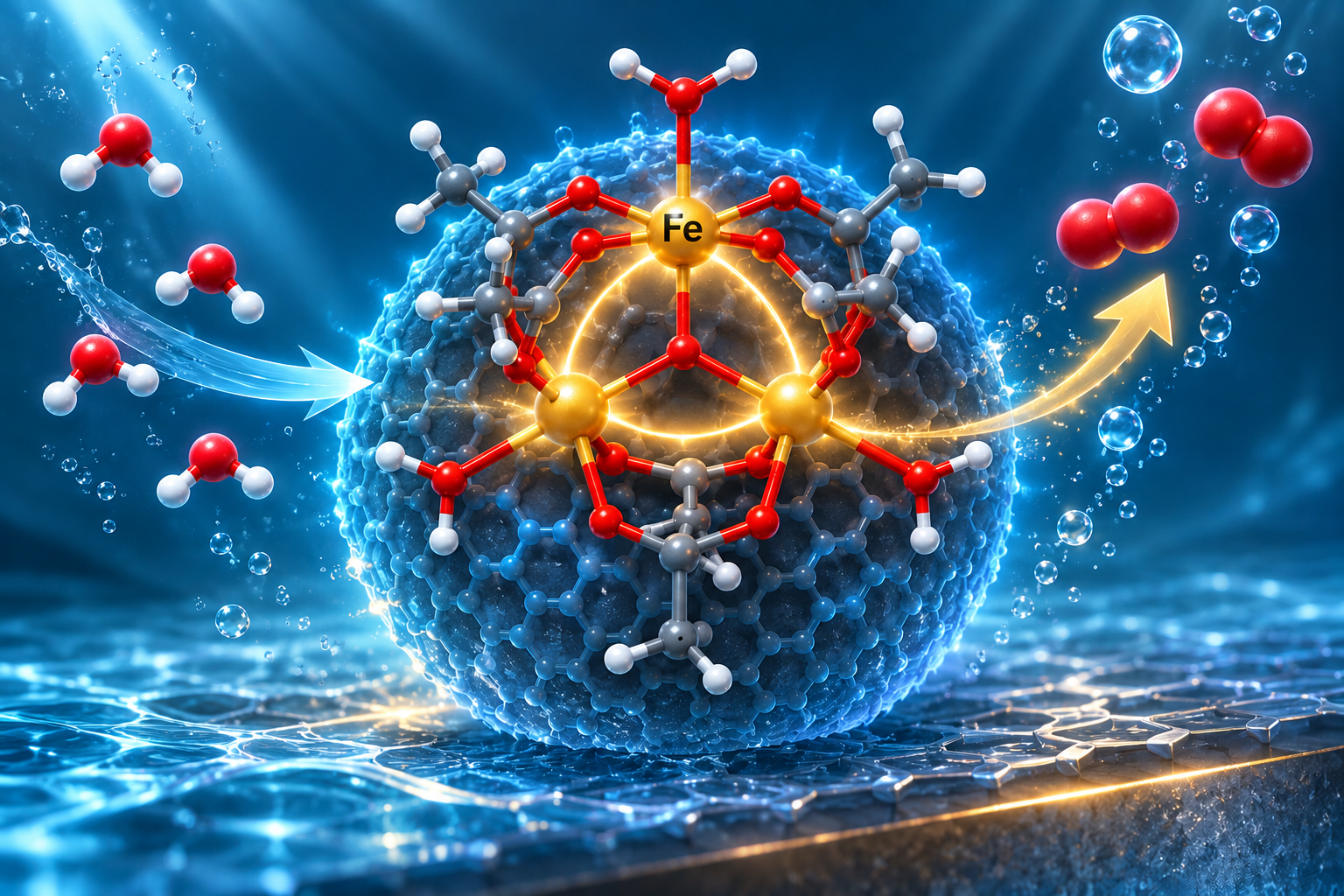
Researchers from CATRIN at Palacký University and the Materials-Envi Lab (MEL) at VŠB-TUO, together with colleagues from France and Italy, have developed a new approach to improving the efficiency of water electrolysis, published in the journal Advanced Functional Materials. The innovative method combines three neighbouring iron atoms with specially designed carbon dots, creating a cooperative system that significantly enhances the electrochemical production of oxygen from water.
“We have developed a unique catalytic system in which three adjacent iron atoms form a cooperative center. Each atom is anchored to ultra-small carbon dots and electronically connected to the others. What makes this system special is that the iron atoms do not operate independently. Instead, they interact, exchange electrical charge, and cooperate throughout the catalytic reaction, while the surrounding carbon nanostructure actively promotes electron transfer,” explained Radek Zbořil, corresponding author, who works at CATRIN in Olomouc and also heads the MEL Center for Energy and Environmental Technologies.
Water electrolysis is a key technology for producing green hydrogen using renewable electricity. However, its efficiency is significantly limited by the slow oxygen evolution reaction (OER), which represents one of the main bottlenecks in the electrolytic splitting of water.
“By combining clusters of iron atoms with an electronically optimized carbon structure, we achieved outstanding catalytic performance in the oxygen evolution reaction, requiring an overpotential of just 110 mV. Under our experimental conditions, the new catalyst even outperformed the reference catalyst based on ruthenium oxide (RuO₂). Importantly, rather than relying on precious metals, we used iron, which is both abundant and inexpensive,” added Aris Bakandritsos, another corresponding author from CATRIN and MEL.
The study also highlights the potential of combining nanotechnology and single-atom engineering to tackle major challenges in sustainable energy technologies. The findings demonstrate that catalyst properties can be tailored not only by controlling individual atom centers but also by engineering interactions between neighboring atoms and the nanostructures that support them. This strategy could therefore inspire the development of catalysts for other reactions relevant to sustainable chemistry and energy.