Publikace v časopise Bioorganic Chemistry
Substituted diiminoisoindoles as anticancer agents: synthesis, structural characterization, and biological evaluation
Authors: Stanislava Majerová, Otakar Pojmon, Filip Verunáč, Lukáš Vlk, Ján Vančo, Veronika Novakova, Zdeňka Růžičková, Petr Štěpnička, Zdeněk Dvořák, Zdeněk Trávníček, Aleš Růžička
Full-text: https://doi.org/10.1016/j.bioorg.2026.110622
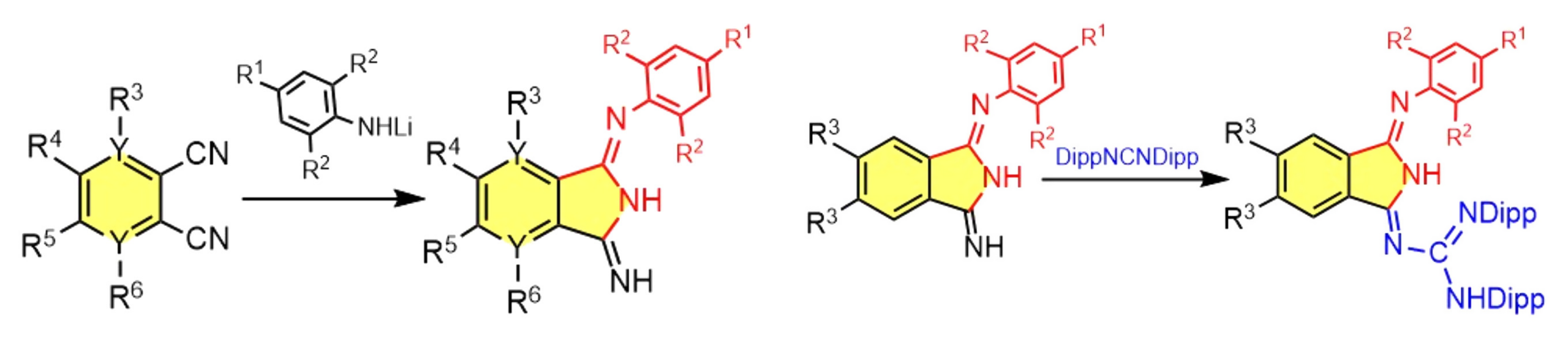
Substituted diiminoisoindoles (DIIs), 1– 20, were synthesized as a nitrogen-rich scaffolds for evaluation of their anticancer activity. Selected DIIs were further converted into DII–guanidine conjugates via carbodiimide-mediated guanylation. Structural characterization showed that isomer populations depend on electron donation from aryl substituents, while solid-state structures consistently exhibit the H-bond stabilized imino-amino tautomeric forms. Electrochemical studies revealed irreversible oxidation and reduction processes consistent with frontier-orbital control by the iminoisoindole and guanidine/aryl substituents. In vitro cytotoxicity was evaluated against a panel of six human cancer cell lines, including the cisplatin-resistant A2780R. Most of the DIIs showed significant-to-moderate cytotoxicity, with IC50 ≈ 3–33 μM, with the best-performing di-tBu sulfide-substituted compound (13) on A2780R (IC50 ≈ 3 μM). The initial Hansch-type QSAR models, based on the lipophilicity and dipole moment descriptors, indicated that lipophilicity was the most influential parameter, with a positive coefficient indicating that greater hydrophobicity enhances biological potency, likely by improving membrane permeability or strengthening hydrophobic interactions at the target site. The QSAR models, together with the docking studies at the Sudlow I binding site, may be used as a predictive tool for the further development of DII derivatives with significant antiproliferative activities and favorable drug-like properties.